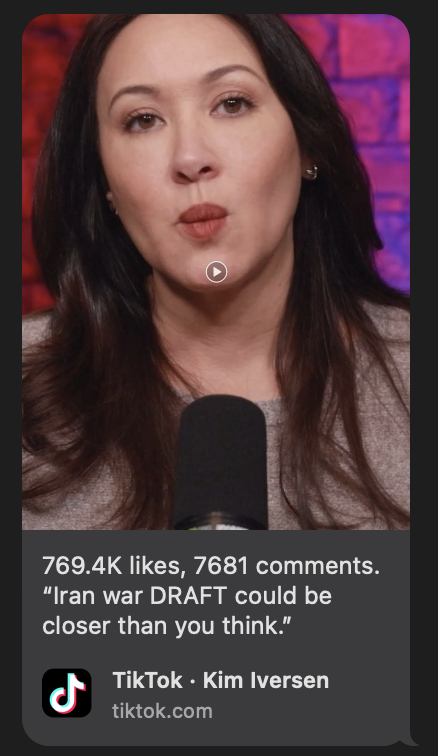
Recently, I came across a TikTok that claimed the United States might soon initiate a military draft because of tensions involving Iran. Since I know so many people within the age group that could potentially be affected by a draft, the claim immediately caught my attention and made me uneasy. At first, I didn’t fully process what the video was saying, but after a moment it hit me and I became curious and honestly, a little concerned. Instead of immediately verifying the information, I did what many people tend to do…which is, I mentioned it to some coworkers to see if they had heard about it.
They became just as, if not more, curious and concerned as I was. Looking back, that moment reminded me of something discussed in our course materials: people often share information not necessarily because they know it’s true, but because it seems “interesting if true.” Once a claim sounds surprising or alarming enough, it spreads quickly through conversation or social media.
After talking with my coworkers, I sent the TikTok video to my husband, who previously served in the Navy to get his thoughts. He immediately pointed out that I probably didn’t have the full story and explained that the United States does not currently have an active military draft, even though men are still required to register with the Selective Service System. Hearing this made me realize I needed to slow down and actually verify the claim myself instead of just assuming the TikTok video was accurate.
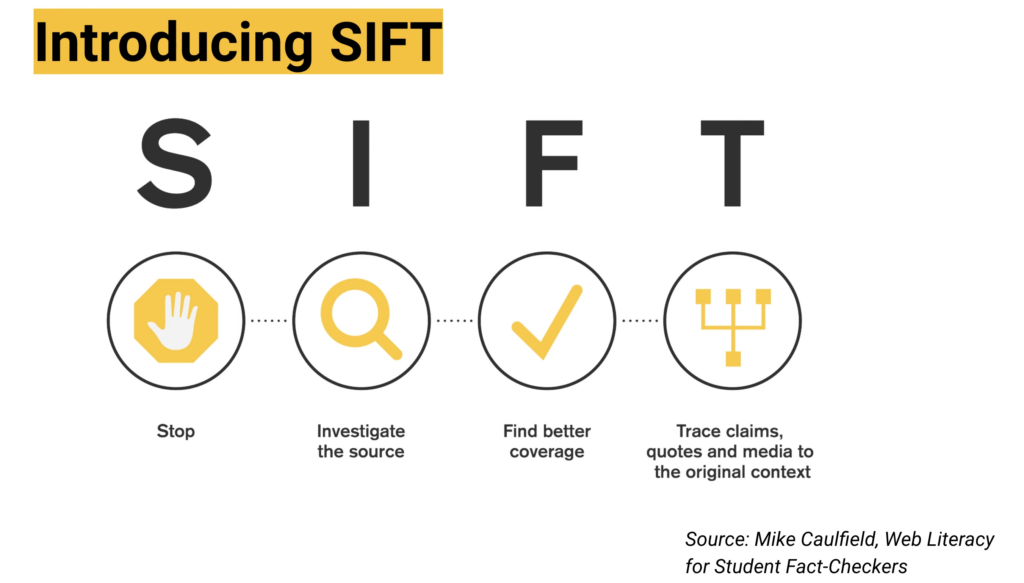
To investigate the claim, I used the SIFT method and lateral reading, which we just learned about in Module 4 of our course.
Step 1: Stop
The first step in the SIFT method is to stop before reacting or sharing the information further. The TikTok video used a dramatic tone and made the situation sound urgent, which can be a red flag when evaluating online claims. If the United States were truly about to implement a military draft, that would be a major national policy change. News like that would almost certainly be reported by multiple credible news outlets, not just a TikTok video.
Step 2: Investigate the Source
Next, I looked into the credibility of the sources discussing the issue. During my search I found an article explaining the rumors about a possible draft from Fox 11 Los Angeles.
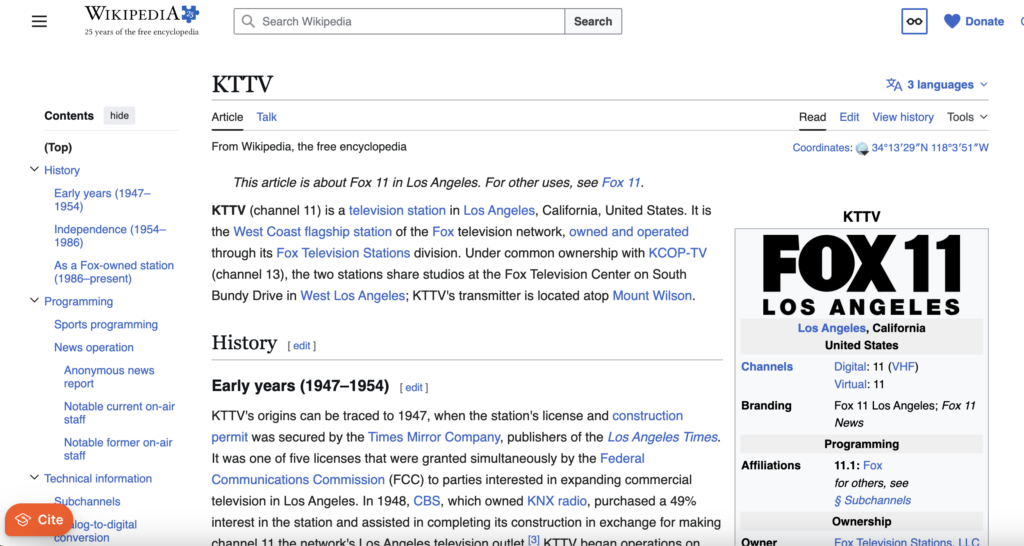
Instead of assuming the site was credible, I used another SIFT strategy: investigating the source itself. One of the course videos suggests quickly checking a source’s background using Wikipedia. I searched for information about the television station behind the article and found a page about KTTV, the Los Angeles television station that operates Fox 11.
The page explained that KTTV is a television station owned by Fox Television Stations and produces local news programming in the Los Angeles area. This helped me understand that the article came from a recognized local news outlet rather than an unknown website or blog.
Step 3: Find Better Coverage
The next step was to find better coverage by checking additional reliable sources. Instead of relying on the one article, I opened up new tabs and searched to see if other news organizations were reporting the same information.
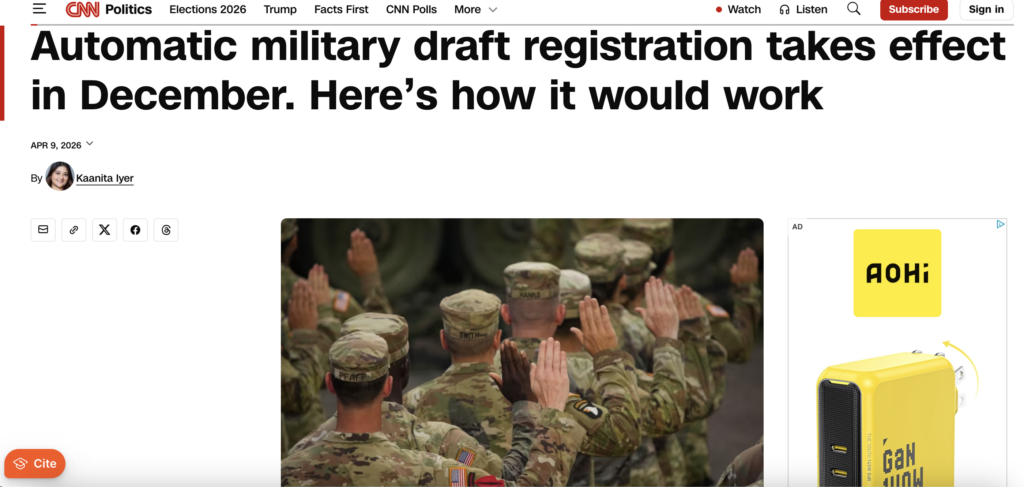
During this step I found reporting from CNN explaining the situation surrounding the rumors about a potential draft.
The article further explained that some policy discussions involve automatically registering eligible men with the Selective Service system, but this does not mean that the United States is implementing a military draft. Simply put, the change would just streamline the registration process that men ages 18-25 are already required to complete.
Seeing multiple news outlets explain the same situation helped clarify that the TikTok video was likely exaggerating the issue.
Step 4: Trace the Claim Back to the Original Context
Finally, I tried to understand the original context behind the claim. After reading more about the Selective Service system, I learned that men in the United States have been required to register for decades. However, the country has operated with an all-volunteer military since the Vietnam War, and there has not been an active draft since 1973.
This means the TikTok video likely took a real piece of information, Selective Service registration, and presented it in a way that made it sound like a new emergency policy being put in place.
The SIFT tutorial videos we watched in class emphasize that tracing claims back to their original context is one of the most effective ways to identify misinformation.
My Final Assessment
After going through these steps, my conclusion is that the TikTok claim was misleading. The United States is not currently implementing a new military draft. Instead, the video appears to misrepresent already existing Selective Service policies in a way that created heightened fear.
This experience actually helped me see how easily misinformation can spread, and not just online, but also through everyday conversations. I initially mentioned the claim to coworkers before verifying it myself, which could have easily created more confusion or concern about the issue among people within the age range for a possible draft.
Using strategies like lateral reading and the SIFT method helped me slow down, investigate the claim, and find credible sources that explained the situation more clearly. This process reminded me that taking just a few minutes to verify information can prevent misinformation from spreading like wildfire and help people make more informed decisions about what they believe online.